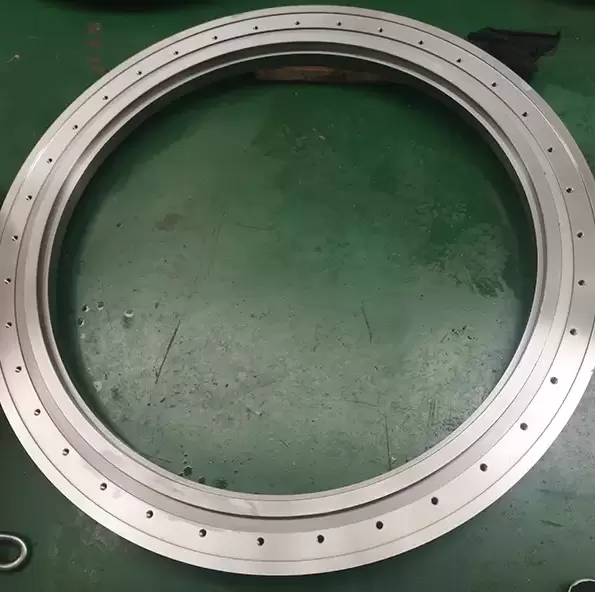
Ring forging precision machining has become a cornerstone technology for manufacturing components that demand unmatched strength, durability, and dimensional accuracy. From aerospace and energy systems to heavy industrial equipment and high-performance mechanical assemblies, forged rings serve as the structural backbone of critical applications. As manufacturing standards continue to tighten and global supply chains focus on reliability, the ability to produce forged rings with both metallurgical integrity and micron-level precision has never been more important.

Among the manufacturers leading this capability, Jiangxi Hongdu Precision Machinery stands out for combining high-pressure forging technology with multi-axis CNC machining, enabling stable production of complex ring geometries with superior performance characteristics.
1. Why Ring Forging Remains the Superior Manufacturing Method
A. Metallurgical Advantages
Ring forging uses compressive forming forces to realign grain flow, producing a structure that is continuous, compact, and extremely resistant to fatigue and impact. Compared with casting or fabrication:
Directional grain flow follows the ring’s shape, significantly enhancing tensile strength.
Reduced internal defects such as porosity, shrinkage, or micro-cracks.
Higher reliability under high temperature, high load, or rotational stress.
This makes forged rings essential in turbine housings, bearings, gear rings, slewing rings, flanges, petrochemical reactors, and aircraft engine assemblies.
B. Dimensional Stability Under Stress
Even after extended service life, forged rings maintain dimensional consistency due to their homogeneous internal structure. This allows precision-machined rings to operate in extreme environments such as:
High-speed rotational systems
High-pressure containment systems
Thermal cycling conditions
2. Precision Machining: The Critical Step After Forging
Forging provides the strength—precision machining provides the accuracy.
Modern industrial systems require forged rings with tolerances often below ±0.01 mm, surface finishes down to Ra0.8 μm, and complex profile transitions.
A. Multi-Axis CNC Machining for Complex Geometries
The machining phase typically involves:
3-axis to 5-axis CNC turning
High-precision milling of grooves, tapers, and flanges
Circular interpolation for ID/OD control
Fine grinding for ultra-smooth surfaces
Coordinate measuring inspection (CMM)
At Jiangxi Hongdu Precision Machinery, machining lines are equipped with digital tooling compensation and intelligent control systems to ensure deviation-free machining even in large-diameter rings.
B. Heat Treatment Integration
Precision machining is often paired with optimized heat treatment cycles:
Normalizing for grain refinement
Quenching and tempering for toughness
Solution and aging treatments for alloy steels or aluminum alloy rings
This ensures the final product meets mechanical property requirements before fine finishing.
C. Tooling Engineering for High-Alloy Materials
Many ring applications require difficult-to-machine materials such as:
Alloy steels (42CrMo4, 4340, 17CrNiMo6)
Stainless steels (304, 316, 410)
Nickel-based superalloys (Inconel, Hastelloy)
Titanium alloys
These materials generate high cutting forces and heat, demanding optimized tool paths, coated carbide tooling, and rigid fixturing solutions. Jiangxi Hongdu Precision Machinery engineers machining strategies based on simulation data to reduce tool wear and maintain consistency in batch production.
3. Application Industries Where Ring Forging Precision Machining Is Essential
(1)Aerospace Engineering
Forged rings are used in:
Turbine engine casings
Gearbox housings
Bearing rings
Structural connectors
Here, the priority is weight reduction while maintaining high fatigue resistance.
(2)Wind Energy and Power Generation
Large-diameter rings (1–8 meters) are needed for:
Wind turbine main bearings
Generator housings
Flange connections
Precision machining ensures the concentricity required for stable rotation over decades.
(3)Petrochemical and Oil & Gas
High-pressure containment systems rely on:
Reactor flanges
Pressure vessel rings
Subsea connection components
These rings must withstand corrosive environments and high cyclic stress.
(4)Heavy Machinery and Automotive
Applications include:
Gear rings for mining equipment
Differential housings
High-load bearing races
Mass production requires strict machining repeatability—an area where computerized quality control systems are essential.
4. How Jiangxi Hongdu Precision Machinery Ensures Reliable Production Quality
A. Advanced Forging Capabilities
The factory operates with:
High-tonnage hydraulic presses
Precision ring rolling machines
Digitally monitored forging temperatures
Inline ultrasonic flaw detection
This ensures structural integrity before machining begins.
B. Integrated Precision Machining Workshops
Machining lines feature:
High-rigidity CNC turning centers
Automatic tool measurement systems
Real-time spindle vibration monitoring
Coordinate measuring machines (CMM) for batch inspection
This integration reduces lead time while guaranteeing consistent accuracy.
C. Traceability and Quality Control
Every ring is assigned a complete traceability system, including:
Material certificates
Forging temperature curves
Machining dimensional reports
Heat treatment process records
This level of transparency is essential for aerospace, energy, and OEM customers.
5. Trends Driving the Future of Ring Forging Precision Machining
A. Digital Twins and Machining Simulation
Virtual machining verifies tool paths and deformation behavior, reducing trial-and-error in complex ring machining.
B. Automated Measurement and Closed-Loop Correction
Inline measurement systems automatically adjust tooling offsets to maintain micron-level accuracy.
C. Lighter and Stronger Alloys
A shift toward titanium and nickel-based alloys increases the demand for high-performance forging and machining systems.
D. Greener Manufacturing
Forging energy recovery, cutting fluid recycling, and low-waste machining will shape the next decade of manufacturing.
Conclusion
Ring forging precision machining is a highly specialized process that merges metallurgical strength with advanced machining accuracy. It ensures components can operate safely under extreme loads, high rotational speeds, and severe environmental conditions. By integrating modern forging technologies, automated CNC machining, and comprehensive quality control, Jiangxi Hongdu Precision Machinery provides engineered solutions that meet the rising standards of global industrial sectors.

 Arabic
 French
 Spanish
 Portuguese
 Deutsch
 Turkish
 Dutch
Dutch
 Italiano
 Russian
 Romaian
 Portuguese (Brazil)
 Greek
Greek