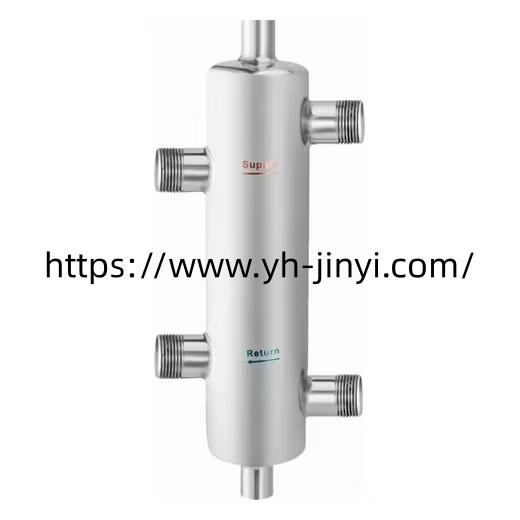
Decoupling Tank plays a valuable role in improving how building energy systems operate by helping separate primary and secondary circulation loops. This separation allows each loop to work under conditions that suit its own design requirements, reducing unnecessary energy consumption while supporting stable system performance across different load scenarios.
In many modern buildings, heating and cooling networks serve multiple zones with different temperature and flow demands. Without proper hydraulic separation, pumps often work harder than necessary to overcome pressure imbalances and flow conflicts. By introducing a thermal buffer between these circuits, system designers can stabilize flow behavior, allowing each pump to operate closer to its intended working range. This alone contributes to noticeable reductions in energy use over time.
One important advantage is improved temperature control. When supply and return flows are properly balanced, temperature distribution becomes more consistent throughout the building. Spaces experience fewer fluctuations, and the central plant avoids frequent cycling caused by sudden demand changes. This stability reduces wear on mechanical equipment while helping the entire system maintain steady performance.
From a system planning perspective, such separation also supports flexible expansion. As buildings add new zones, modify layouts, or integrate renewable energy sources, hydraulic decoupling helps accommodate these changes without forcing major redesigns of existing infrastructure. Engineers can connect new circuits while maintaining predictable operation of the original system.
Pump energy consumption represents a significant portion of building operating costs. When circulation loops interfere with one another, pumps must compensate by increasing speed and pressure. Hydraulic separation reduces this interference, allowing pumps to operate more efficiently. Over the life of the system, this translates into lower energy demand and improved cost control for facility owners.
Another factor is equipment longevity. When flow turbulence and pressure swings are minimized, components such as valves, heat exchangers, and pumps experience less mechanical stress. Reduced strain leads to fewer breakdowns and lower maintenance frequency. Over time, this stability helps maintain reliable building operation while keeping service expenses more predictable.
Building automation systems also benefit from more stable hydraulic behavior. Sensors and control algorithms perform more accurately when temperature and flow conditions are consistent. This enables better control strategies, including demand based pumping, staged heating and cooling, and precise zone management. All of these contribute to improved energy efficiency without increasing system complexity.
JINYI provides equipment solutions designed to support these operational goals across a wide range of commercial and industrial building applications. By focusing on reliable construction, adaptable configurations, and compatibility with modern HVAC designs, JINYI supports engineers and facility managers seeking practical methods to improve building energy performance while maintaining operational stability.
Energy efficiency in buildings is rarely the result of a single component. Instead, it emerges from the coordinated behavior of many interconnected systems. Hydraulic separation allows each part of the network to function more independently, reducing conflict, stabilizing performance, and supporting long term energy management strategies.
As building codes evolve and sustainability expectations continue to grow, system designs that emphasize energy control, operational stability, and adaptability will remain central to successful project planning. Facility managers increasingly prioritize solutions that offer measurable performance improvements without introducing unnecessary complexity.
Those interested in examining specific applications and available configurations may review product information at https://www.yh-jinyi.com/product/decoupling-tank/

 Arabic
 French
 Spanish
 Portuguese
 Deutsch
 Turkish
 Dutch
Dutch
 Italiano
 Russian
 Romaian
 Portuguese (Brazil)
 Greek
Greek