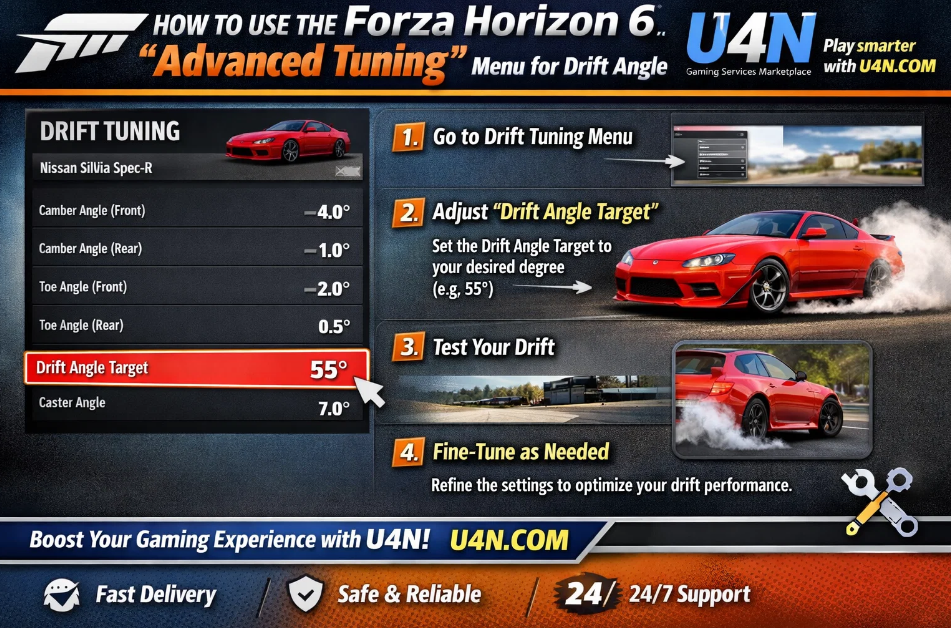
What Is Drift Angle and Why Does It Matter?
Drift angle is the angle between the direction your car is pointing and the direction it is moving during a drift. A higher angle usually looks more impressive and can earn more skill points, but it also makes the car harder to control. Too much angle, and you risk spinning out; too little, and your drifts feel flat and unexciting.
Getting the right balance requires a combination of driving technique and car setup. That’s where the Advanced Tuning menu comes in. By adjusting specific settings, you can make your car easier to control at higher drift angles.
How to Access the Advanced Tuning Menu
-
Open your garage or the “My Cars” menu.
-
Select the car you want to tune.
-
Choose “Upgrades & Tuning.”
-
Scroll down to “Advanced Tuning.”
This menu allows you to adjust multiple parameters affecting your car’s handling. While some options are more important for speed racing, others directly impact drifting.
Key Settings for Drift Angle
Here are the main Advanced Tuning settings you’ll want to focus on for drifting:
1. Tire Pressure
Lowering rear tire pressure can help the car slide more easily, increasing drift angle. Front tires generally need slightly higher pressure to maintain steering response. A typical starting point is 28 PSI front and 25 PSI rear, but you should adjust based on the car’s weight and drivetrain.
Tip: If your car feels twitchy or spins out easily, slightly increase rear pressure. If it’s not sliding enough, decrease it.
2. Camber
Camber is the tilt of the tires inwards or outwards. Negative camber on the front improves steering grip while turning, and slight negative camber on the rear can help maintain stability during drifts. Too much negative camber can reduce overall traction, so start with small changes, like -1 to -2 degrees front and -0.5 to -1 degree rear.
3. Toe
Toe adjustments affect how the car initiates a drift. Front toe-in (front wheels pointing slightly inward) helps with stability, while rear toe-out can make the car easier to rotate. A small change here can dramatically affect how naturally your car starts a drift.
4. Suspension: Ride Height and Stiffness
Lowering ride height lowers the center of gravity, making drifts smoother. However, going too low can cause bottoming out and instability. Adjusting suspension stiffness can also impact drift angle. Softer rear suspension allows easier rotation, while firmer front suspension improves steering response.
5. Anti-Roll Bars
Anti-roll bars control how much the car leans during cornering. Softer rear bars make the rear end more prone to sliding, which is good for drifting. Firmer front bars prevent understeer. A common approach is softer rear and medium-to-firm front.
6. Differential
The differential is key for drift angle. A higher rear differential lock will make the rear wheels spin together, making it easier to sustain a drift. Front-wheel differential settings affect understeer and turn-in. For RWD drift cars, set a high rear lock (70–100%) and adjust acceleration vs. deceleration locks to taste.
Practical Steps to Find the Right Drift Setup
-
Start with a baseline: Use a standard RWD car with stock settings.
-
Make small adjustments: Change one parameter at a time, like rear tire pressure or suspension stiffness.
-
Test in a controlled area: Use the Horizon Festival drift zones or a wide open road.
-
Note the effects: Track how the car responds and how much angle you can sustain.
-
Refine gradually: Adjust different parameters until you reach a balance between drift angle and control.
This process may take time, but it’s the best way to understand how each setting affects your drifting.
Common Mistakes to Avoid
-
Overcomplicating the setup: Many players try to max out all settings for extreme angle. This often backfires, making the car uncontrollable. Focus on small, complementary adjustments.
-
Ignoring driving technique: Tuning alone won’t make you a pro. Smooth throttle control and steering are just as important as setup.
-
Skipping testing: Changes can feel fine in the tuning menu but behave differently in motion. Always test after adjustments.
Using Advanced Tuning in Conjunction with Upgrades
While Advanced Tuning is powerful, it works best when combined with performance upgrades. Upgrades like drift tires, suspension kits, and lighter chassis components can amplify the effects of tuning. Some players even buy specific cars from the FH6 credits online store that are already better suited for drifting, then fine-tune them in the Advanced Tuning menu.
Example Drift Setup
Here’s a practical starting setup for a typical RWD drift car:
-
Front Tire Pressure: 28 PSI
-
Rear Tire Pressure: 25 PSI
-
Front Camber: -1.5°
-
Rear Camber: -0.5°
-
Front Toe: +0.1°
-
Rear Toe: -0.2°
-
Front Suspension: Medium
-
Rear Suspension: Soft
-
Front Anti-Roll Bar: Medium
-
Rear Anti-Roll Bar: Soft
-
Rear Differential Lock: 80%
Adjust each value slightly based on your preferred car and drift style. The goal is a car that rotates smoothly without spinning out.
Tips for Better Drift Angle Control
-
Smooth throttle: Avoid stomping the gas mid-drift; gradual input helps maintain angle.
-
Counter-steering: Adjust steering opposite the slide to hold the angle.
-
Feathering the brake: Light braking can help initiate or extend a drift without losing control.
-
Practice in zones: FH6 has drift zones and events designed for experimentation. Repeating these will build muscle memory for better angle control.
The Advanced Tuning menu in Forza Horizon 6 gives players the tools to fine-tune drift angle with precision. By understanding tire pressures, suspension settings, differentials, and more, you can create a setup that matches your driving style. Remember, tuning alone isn’t enough—technique and practice are equally important. With careful adjustments and patience, you can maintain higher drift angles consistently while keeping control.
Combining this with strategic car upgrades, including options from the FH6 credits online store, allows even newer players to access cars that respond well to tuning, making the drift learning curve less steep.

 English
 Arabic
 French
 Spanish
 Portuguese
 Deutsch
 Turkish
 Dutch
Dutch
 Russian
 Romaian
 Portuguese (Brazil)
 Greek
Greek