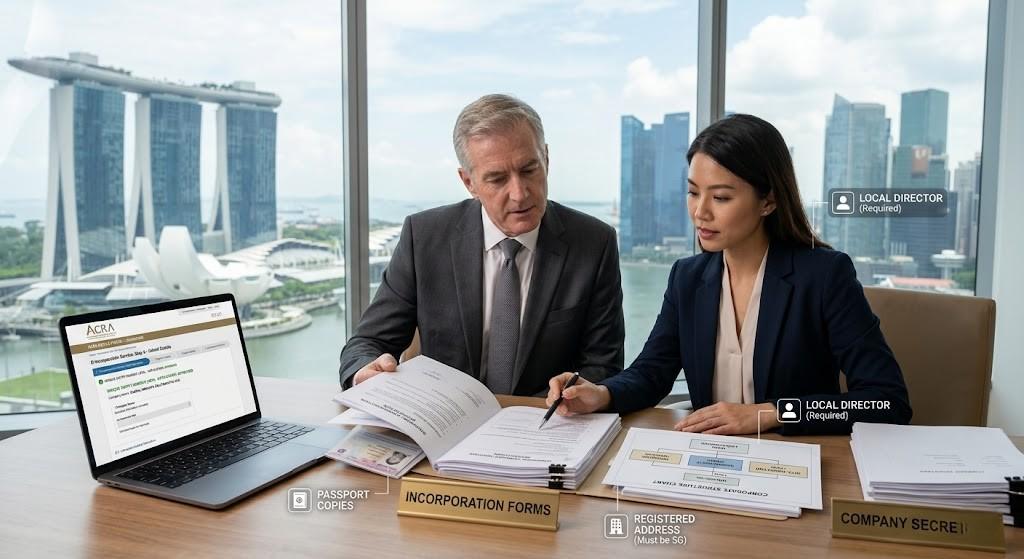
Foreign business entities increasingly recognize Singapore as the optimal gateway to Southeast Asian markets. The city-state's compelling combination of regulatory transparency, tax efficiency, and world-class infrastructure creates an environment where international operations can thrive. However, accessing these benefits requires navigating a specific regulatory pathway and maintaining consistent compliance standards.
This guide provides foreign business entities with essential insights for Singapore establishment. From entity selection through ongoing governance, we cover the critical elements that determine operational success.
Choosing Your Business Structure: Subsidiary or Branch
Foreign business entities must make a fundamental structural decision when entering Singapore. This choice shapes liability exposure, operational flexibility, and long-term strategic options.
Incorporating a private limited company offers the first pathway. This creates a separate legal entity with full corporate capacity under Singapore law. The legal separation provides crucial protection—local liabilities remain confined to the subsidiary without affecting parent entity assets. Banks, suppliers, and partners typically view this structure favorably, and it qualifies for Singapore's tax incentives and extensive treaty network. Most foreign business entities choose this route for regional headquarters or significant operations.
Registering a branch office presents the alternative. This structure treats the Singapore presence as an extension of the foreign parent entity. While this may simplify some internal processes, it creates unlimited liability exposure for the parent company. Branch operations must also file parent company financial statements with local authorities. Some industries prefer this direct connection, but liability concerns drive most entities toward subsidiary status.
Engaging corporate secretarial services early in this decision process helps ensure your chosen structure aligns with your risk profile and business objectives.
Mandatory Requirements for Foreign-Owned Entities
Singapore imposes strict, non-negotiable requirements on foreign business entities. Understanding these from the outset prevents costly delays and complications.
Local director residency is essential. Every Singapore company must have at least one director who is ordinarily resident—a citizen, permanent resident, or employment pass holder with a local address. Entities without suitable candidates often rely on corporate secretarial services to provide nominee director arrangements. Given the legal responsibilities involved, this appointment requires careful consideration.
The company secretary role is equally mandatory. Within six months of incorporation, every entity must appoint a qualified secretary. This individual ensures compliance with corporate law, maintains statutory records, and handles required filings. The position cannot remain vacant. Many foreign business entities find that professional company secretary services provide the expertise and reliability they need.
A registered office address in Singapore is compulsory. This must be a physical location capable of receiving official documents—not a post office box. Most entities use addresses provided by their company secretary services provider, ensuring compliance while maintaining a professional presence.
Paid-up capital requirements are minimal. Most industries face no minimum threshold, meaning even one Singapore dollar technically satisfies the requirement. However, practical business needs typically dictate higher amounts. Banks, landlords, and suppliers generally expect more substantial capital commitments.
The Value of Professional Support
Attempting to navigate Singapore's regulatory environment without local expertise is possible but risky. The rules are precise, documentation requirements are exacting, and penalties for non-compliance can be significant.
Reputable corporate secretarial services firms manage the entire incorporation process. They prepare necessary documentation, liaise with ACRA, and ensure your structure meets all legal requirements. After incorporation, they assist with essential tasks like opening bank accounts and obtaining necessary licenses.
The company secretary's role extends well beyond paperwork. A qualified secretary provides governance advice, tracks compliance deadlines, and prepares board resolutions. For entities unfamiliar with Singapore's legal environment, this expertise is invaluable. Outsourcing to specialist company secretary services reduces risk, ensures continuity, and allows management to focus on business development rather than administrative compliance.
Ongoing Compliance Obligations
Incorporation marks only the beginning of your regulatory responsibilities. Singapore expects consistent compliance, and enforcement is strict.
Annual General Meetings remain mandatory for private companies, though some flexibility exists in timing and format. Financial statements must be presented to shareholders, and Annual Returns must be filed with ACRA within strict deadlines. Late filing triggers automatic penalties.
Tax compliance is equally rigorous. IRAS requires annual returns regardless of profitability. Entities with annual turnover exceeding SGD 1 million must register for GST. Accounting records must be kept up to date and made available to auditors or regulators upon request.
Changes in company circumstances require prompt disclosure. New director appointments, address changes, and share issuances must be reported to ACRA within 14 days. While the company secretary typically manages these filings, directors retain ultimate legal responsibility.
Practical Tips for Market Entry
Experience with numerous foreign business entities reveals several lessons worth sharing.
Begin preparations well ahead of your target launch date. While ACRA processes incorporations quickly, gathering required documents—especially from overseas parent companies—takes considerably longer. Have identification documents, proof of address, and parent company documentation ready. Branch registrations require additional certified documents from the home jurisdiction.
Select your business activity code carefully. Singapore uses specific codes to classify business activities, and your choice affects licensing requirements and tax treatment. If uncertain, seek guidance from your corporate secretarial services provider.
Prepare thoroughly for banking relationships. Opening corporate accounts can take several weeks, as banks conduct extensive due diligence on foreign-owned entities. Have a solid business plan ready, and be prepared to explain your ownership structure clearly. Relationships with established local service providers help build bank confidence.
Prioritize clear communication. Time zone differences and language barriers can cause misunderstandings. Work with advisors who respond promptly and explain requirements in plain language, not legal jargon.
Why Local Expertise Matters
Singapore's business environment is efficient but unforgiving of errors. Forms must be completed precisely. Deadlines are absolute. Regulatory interpretations can vary by context. Local expertise navigates these nuances effectively.
Experienced professionals know which filings can be submitted online, when to seek clarification from regulators, and how to structure documentation to meet requirements. Attempting to manage this from abroad often leads to mistakes—missed deadlines, incorrect forms, and misunderstood requirements. The cost of fixing these errors usually exceeds the cost of getting it right initially.
Engaging company secretary services is an investment in certainty. These specialists act as your local anchor, ensuring compliance while you focus on growth. A reliable corporate secretarial services provider becomes a strategic partner, helping you navigate governance decisions, shareholder matters, and regulatory changes.
Final Thoughts
Singapore offers foreign business entities an outstanding platform for Asian expansion. The market is open, the infrastructure is excellent, and the rule of law is strong. Success depends on getting the fundamentals right.
Choose your structure carefully. Meet all local requirements. Appoint qualified professional support. File on time. Keep good records. These steps may not be exciting, but they protect your investment and build credibility.
You don't have to do this alone. Singapore has a robust professional services sector ready to help. Find advisors who understand your business and share your commitment to doing things properly. With the right foundation, your Singapore entity can thrive—freeing you to focus on what you do best: growing your business.

 Arabic
 French
 Spanish
 Portuguese
 Deutsch
 Turkish
 Dutch
Dutch
 Italiano
 Russian
 Romaian
 Portuguese (Brazil)
 Greek
Greek