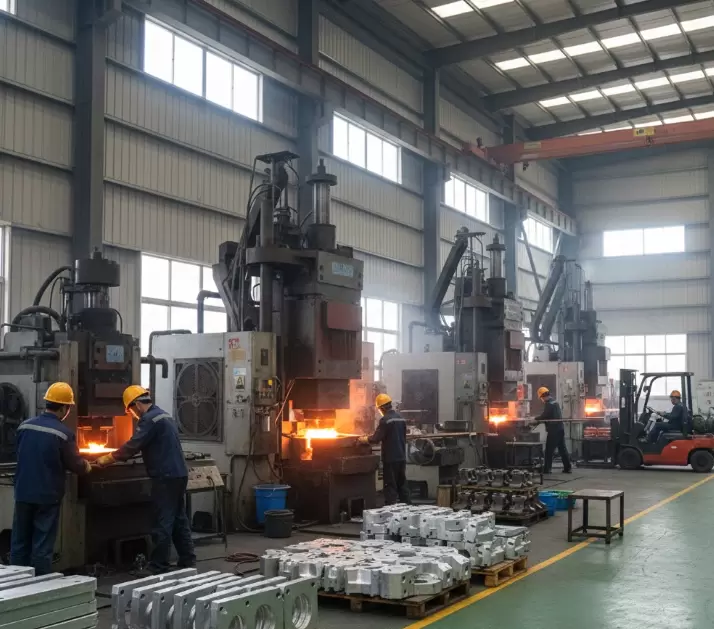
In high-performance industries such as aerospace, automotive, energy, and heavy machinery, material selection and manufacturing processes directly determine product reliability and lifecycle cost. Among various metal forming technologies, aluminum forging stands out for its ability to deliver exceptional strength-to-weight ratios, structural integrity, and fatigue resistance. However, these benefits are only fully realized when manufacturers partner with experienced aluminum forging suppliers capable of meeting strict engineering and quality requirements.

Why Aluminum Forging Remains a Strategic Manufacturing Choice
Aluminum forgings are produced by applying compressive forces to aluminum alloys, aligning the grain flow to match part geometry. Compared with casting or machining from billet, forging offers measurable performance advantages:
-
Superior mechanical strength and fatigue resistance
-
Reduced internal defects and porosity
-
Higher load-bearing capacity at lower weight
-
Improved dimensional stability under stress
These characteristics make forged aluminum components essential in applications where safety, durability, and weight optimization are critical.
The Expanding Role of Aluminum Forging Suppliers in Modern Industry
Today’s aluminum forging suppliers are no longer just part producers; they are engineering partners. Leading suppliers contribute to:
-
Early-stage design for manufacturability (DFM)
-
Alloy selection based on mechanical and thermal requirements
-
Process optimization to reduce material waste and machining cost
-
Quality assurance aligned with international standards
As product complexity increases, supplier expertise becomes a decisive competitive factor.
Key Capabilities to Look for in Aluminum Forging Suppliers
1. Alloy Expertise and Material Control
Professional aluminum forging suppliers must be proficient with common and high-performance alloys such as 6061, 6082, 7075, and 2024. Each alloy presents distinct trade-offs in strength, corrosion resistance, and machinability.
Reliable suppliers maintain strict control over:
Raw material traceability
Chemical composition compliance
Heat treatment consistency
2. Forging Process Diversity
A capable supplier should support multiple forging processes, including:
Open-die forging for large structural components
Closed-die forging for high-precision, high-volume parts
This flexibility allows manufacturers to adapt to different project scales and performance requirements.
3. Precision Machining Integration
Modern aluminum forging suppliers often integrate CNC machining, enabling tighter tolerances and reduced lead times. This vertical integration minimizes outsourcing risks and ensures consistency between forged blanks and finished components.
Quality Standards: A Non-Negotiable Requirement
For industrial buyers, quality assurance is a decisive factor when selecting aluminum forging suppliers. Advanced suppliers implement:
-
ISO-compliant quality management systems
-
Non-destructive testing (UT, MT, PT)
-
Mechanical property testing and dimensional inspection
Jiangxi Hongdu Preciosion Machinery places strong emphasis on quality traceability and inspection protocols, ensuring forged components meet demanding performance and safety standards across industries.
Why Jiangxi Hongdu Preciosion Machinery Stands Out
As a professional manufacturer in the forging and precision machining sector, Jiangxi Hongdu Preciosion Machinery has established itself as a reliable aluminum forging supplier for both domestic and international markets.
Core Strengths
-
Strong engineering support from concept to production
-
Stable production capacity for small batches and mass orders
-
In-house machining to ensure dimensional accuracy
-
Experience serving high-demand industrial applications
By combining forging expertise with precision machining capabilities, the company supports customers seeking cost-effective, high-performance aluminum forged solutions.
Applications Across Critical Industries
High-quality aluminum forging suppliers support a wide range of sectors, including:
-
Automotive: suspension components, brackets, control arms
-
Aerospace: structural fittings, housings, connectors
-
Energy & Power: forged parts for turbines and equipment frames
-
Industrial Machinery: load-bearing components and transmission parts
In each case, forging reliability directly impacts operational safety and maintenance cycles.
Conclusion: Choosing Suppliers That Forge More Than Parts
Selecting the right aluminum forging suppliers is a strategic decision that affects product performance, cost structure, and brand reputation. Beyond equipment and capacity, suppliers must demonstrate engineering insight, quality discipline, and long-term partnership value.
By working with experienced manufacturers such as Jiangxi Hongdu Preciosion Machinery, companies gain access to dependable aluminum forging solutions that meet modern industrial demands—today and in the future.

 English
 Arabic
 French
 Spanish
 Portuguese
 Deutsch
 Turkish
 Dutch
Dutch
 Italiano
 Romaian
 Portuguese (Brazil)
 Greek
Greek