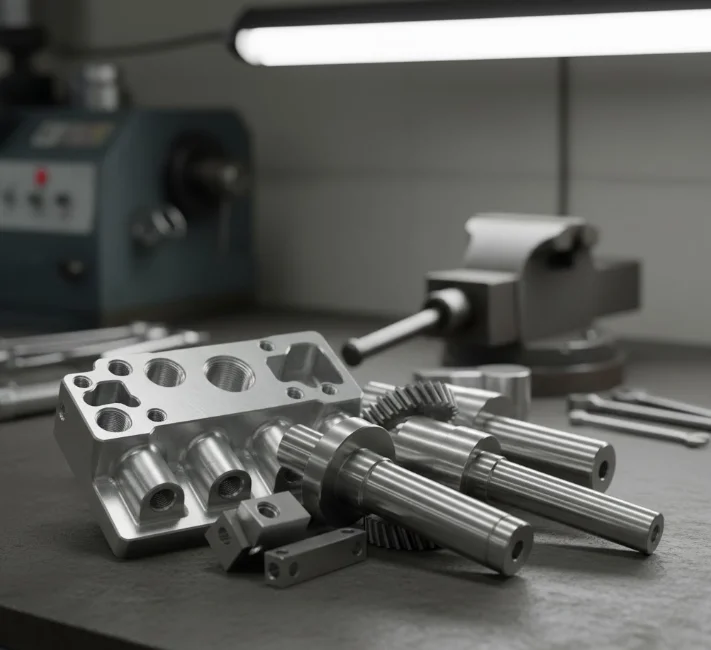
In today’s manufacturing landscape, precision is no longer a competitive advantage—it is a baseline requirement. From aerospace and automotive systems to packaging machinery and industrial automation, product performance depends heavily on the dimensional accuracy, surface integrity, and repeatability of CNC machining components.
CNC machining components are not merely shaped pieces of metal or plastic; they are the physical realization of digital engineering intent. When produced correctly, they translate CAD data into functional, load-bearing, and long-lasting parts. Manufacturers such as AICHI TECHNOLOGY focus on this translation process, ensuring that design intent is preserved from programming to final inspection.
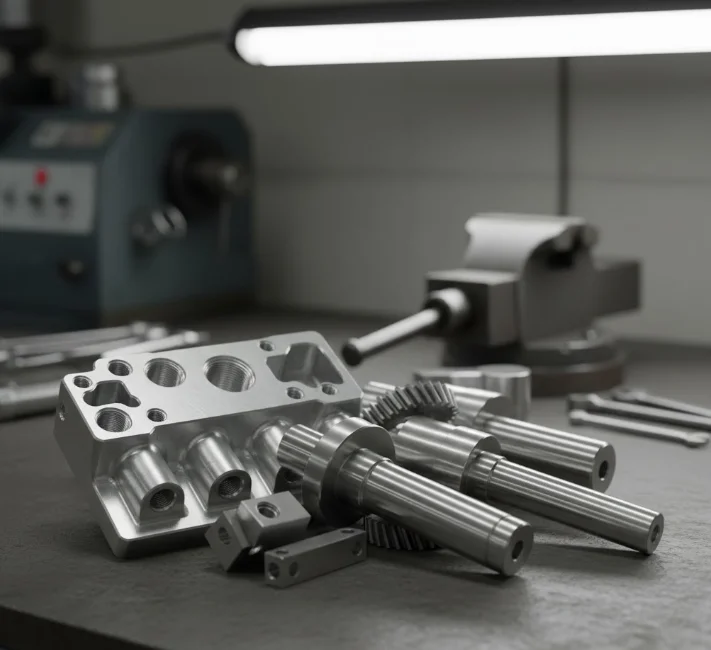
1. What Defines High-Quality CNC Machining Components
At a technical level, CNC machining components are parts manufactured using computer numerical control machines that execute programmed tool paths with high positional accuracy. However, true quality extends beyond nominal dimensions.
Key quality indicators include:
-
Tight and repeatable tolerances
-
Controlled surface roughness and edge integrity
-
Material consistency and internal stress management
-
Dimensional stability across production batches
Poorly controlled machining may meet drawing dimensions initially but fail during assembly or operation. High-quality CNC machining components are engineered for functional reliability, not just dimensional compliance.
2. Material Selection and Machinability Considerations
The performance of CNC machining components is strongly influenced by material choice. Each material introduces unique challenges in cutting behavior, tool wear, and thermal response.
Common materials include:
-
Aluminum alloys for lightweight, high-speed applications
-
Stainless steels for corrosion resistance and strength
-
Carbon steels for structural and load-bearing components
-
Engineering plastics for electrical insulation and low friction
-
Brass and copper alloys for conductivity and precision fittings
AICHI TECHNOLOGY approaches material selection holistically, considering not only mechanical properties but also machinability, dimensional stability, and downstream application requirements.
3. CNC Machining Processes and Their Impact on Component Performance
Milling and Turning Operations
CNC milling and turning form the foundation of most CNC machining components. Multi-axis machining enables complex geometries, undercuts, and compound angles that traditional machining cannot achieve efficiently.
Key process advantages include:
-
High geometric flexibility
-
Consistent repeatability in mass production
-
Reduced human-induced variability
Multi-Axis and Precision Machining
Five-axis CNC machining allows components to be produced in fewer setups, minimizing cumulative error and improving surface continuity. This is critical for precision components used in motion systems, sealing assemblies, and high-speed machinery.
Precision machining also involves:
-
Optimized tool paths to reduce vibration
-
Controlled cutting forces to prevent part distortion
-
Advanced fixturing to maintain alignment
4. Tolerance Control and Functional Accuracy
Tolerance is not simply a number on a drawing—it is a functional requirement. Overly tight tolerances increase cost, while loose tolerances compromise performance.
High-end CNC machining components require:
-
Process capability analysis (Cp, Cpk)
-
Tool wear compensation strategies
-
In-process measurement and verification
-
Post-machining inspection using CMM or optical systems
At AICHI TECHNOLOGY, tolerance strategy is aligned with part function, ensuring components perform as intended without unnecessary manufacturing cost.
5. Industry Applications of CNC Machining Components
Industrial Machinery and Automation
CNC machining components form the structural and functional core of industrial equipment. Guide rails, housings, brackets, and drive components demand dimensional stability and repeatability.
Packaging and Processing Equipment
In packaging machinery, precision affects alignment, sealing accuracy, and operational speed. High-quality CNC machining components reduce downtime and improve system reliability.
Automotive and Transportation
From engine components to fixtures and tooling, CNC machining supports high-volume production with strict quality standards.
Aerospace and High-Tech Industries
These sectors demand extreme precision, traceability, and material integrity—areas where advanced CNC machining excels.
6. Why CNC Machining Components Are a Strategic Manufacturing Asset
CNC machining components deliver strategic value beyond part production:
-
Faster prototyping to production transition
-
Consistent quality across global supply chains
-
Reduced assembly variation
-
Improved lifecycle performance
Manufacturers that invest in advanced CNC machining capability gain long-term advantages in quality, cost control, and customer trust.
Conclusion
CNC machining components are the foundation of precision-driven industries. Their quality determines not only whether a product fits together, but whether it performs reliably under real-world conditions.
By combining advanced machining technology, disciplined process control, and application-driven engineering, AICHI TECHNOLOGY delivers CNC machining components that meet the demands of modern manufacturing—where precision, consistency, and performance are non-negotiable.

 English
 Arabic
 French
 Spanish
 Portuguese
 Turkish
 Dutch
Dutch
 Italiano
 Russian
 Romaian
 Portuguese (Brazil)
 Greek
Greek